

What’s Hiding in Your Air Ducts? Probably More Than Dust.
You vacuum the carpet. You wipe down the shelves. You clean under the couch occasionally, usually after someone loses a remote and the search becomes a family emergency.
Then the afternoon sun hits the living room just right, and suddenly you can see little particles floating through the air.
Lovely. Apparently, the house has been making its own confetti.
You want a home that feels clean and comfortable. You want to know the places you cannot easily reach are getting the attention they need, too. But when was the last time anyone looked inside the ductwork?
Phillips Outdoor Services provides residential air duct cleaning in La Crosse, Onalaska, Holmen, West Salem, and the surrounding Coulee Region. We are a NADCA member company, with trained and certified professionals committed to high standards of HVAC system cleaning.
Our duct-cleaning service also includes complimentary dryer vent cleaning and antibacterial and deodorizing spray service, giving a few more hidden parts of your home the attention they deserve.
The place to begin is understanding what is in your system—and whether it belongs on your home-care list.
What Is Household Dust Actually Made Of?
“Dust” is a remarkably polite name for a collection of things you would probably prefer not to meet individually.
Depending on the home, that collection can include:
- Dead skin flakes shed by people and pets
- Pet hair and dander, including contributions from the dog who is absolutely not allowed on the couch
- Fibers and lint from clothing, carpets, and furnishings
- Pollen and soil particles brought in from outside
- Tiny fragments of dead insects
The National Institute of Environmental Health Sciences identifies skin flakes, pollen, and insect fragments among the materials found in household dust. Dust mites add another unappealing detail: these microscopic creatures feed on shed skin and commonly live in bedding, carpets, and upholstered furniture. NIEHS explains their role in household dust and allergens.
That soft gray fluff suddenly sounds considerably less innocent.
Your home’s dust mixture is unique. You cannot identify everything in it by looking at a vent, and a dusty shelf alone does not tell you whether the ducts need cleaning. But when an inspection reveals substantial buildup inside the system, removing that material gives you a concrete result: the accumulated debris is out of the ductwork.
Sometimes, the Surprise Is Bigger Than a Dust Bunny
On one Phillips duct-cleaning job, our team found the dried, decomposed remains of an opossum inside the ductwork. An actual opossum. That is quite a bit more than the usual lint-and-pet-hair situation. It was an unusual discovery, and it makes a memorable point: the parts of a home you rarely see can hold things you would never knowingly leave there. A room can look beautifully cared for while the ductwork has a very different story to tell.
How Do You Know If Your Air Ducts Need Cleaning?
Reasons to investigate include excessive debris in the ducts, an abundance of dust settling on household furniture and appliances, particles blowing from supply vents, or evidence of pests. The EPA’s homeowner guide explains these situations and recommends cleaning when needed.
Your home’s recent history also helps shape the conversation:
- You finished a remodeling project. Tell us about drywall sanding, flooring work, or other dusty construction, especially if vents were uncovered.
- You bought a home. An unknown service history gives you questions to ask and a reason to find out what condition the system is in.
- You have noticed a persistent odor or unusual debris. Describe when it appears and which rooms are affected so the source can be investigated.
Those details help us understand what to look for. You do not need to diagnose the problem before you call.
Why NADCA Membership and Certification Matter
You should be able to ask who is coming into your home, what training they have, and what standard guides their work. Phillips is a member of the National Air Duct Cleaners Association, or NADCA. Our team includes trained, NADCA-certified professionals, and our approach follows NADCA’s high standards for HVAC system cleaning. NADCA develops standards for HVAC inspection, cleaning, and restoration. Its member companies must have at least one Air Systems Cleaning Specialist (ASCS) on staff, and that certification requires continuing education to maintain. Members work according to ACR, the NADCA Standard. Learn why NADCA membership matters.
For a homeowner, the value is practical. You want people who understand the system they are working on, know how to select appropriate cleaning methods, and can explain the work clearly. At Phillips, that technical training goes alongside the care you should expect from a company working in your home: clear communication, respect for your space, and a chance to understand what was found and cleaned. A clean-looking vent cover is easy to appreciate. Confidence in the work behind it matters just as much.
What Does Professional Air Duct Cleaning Include?
Professional cleaning reaches into the system that moves air through your home. Supply ducts carry conditioned air to rooms; return ducts bring air back to the heating and cooling equipment.
Phillips takes a complete-system approach to duct cleaning. Your proposal should identify the supply and return ductwork, registers and grilles, and furnace or air-handler components covered, along with any access limitations.
Here is the basic process:
- Assess the system and prepare the work area. Understand the layout, access, and condition before cleaning begins.
- Establish negative pressure. A powerful vacuum draws air and loosened debris toward the collection equipment during cleaning.
- Loosen accumulated material. Specialized tools dislodge buildup so it can be extracted. Tool selection should suit the duct material.
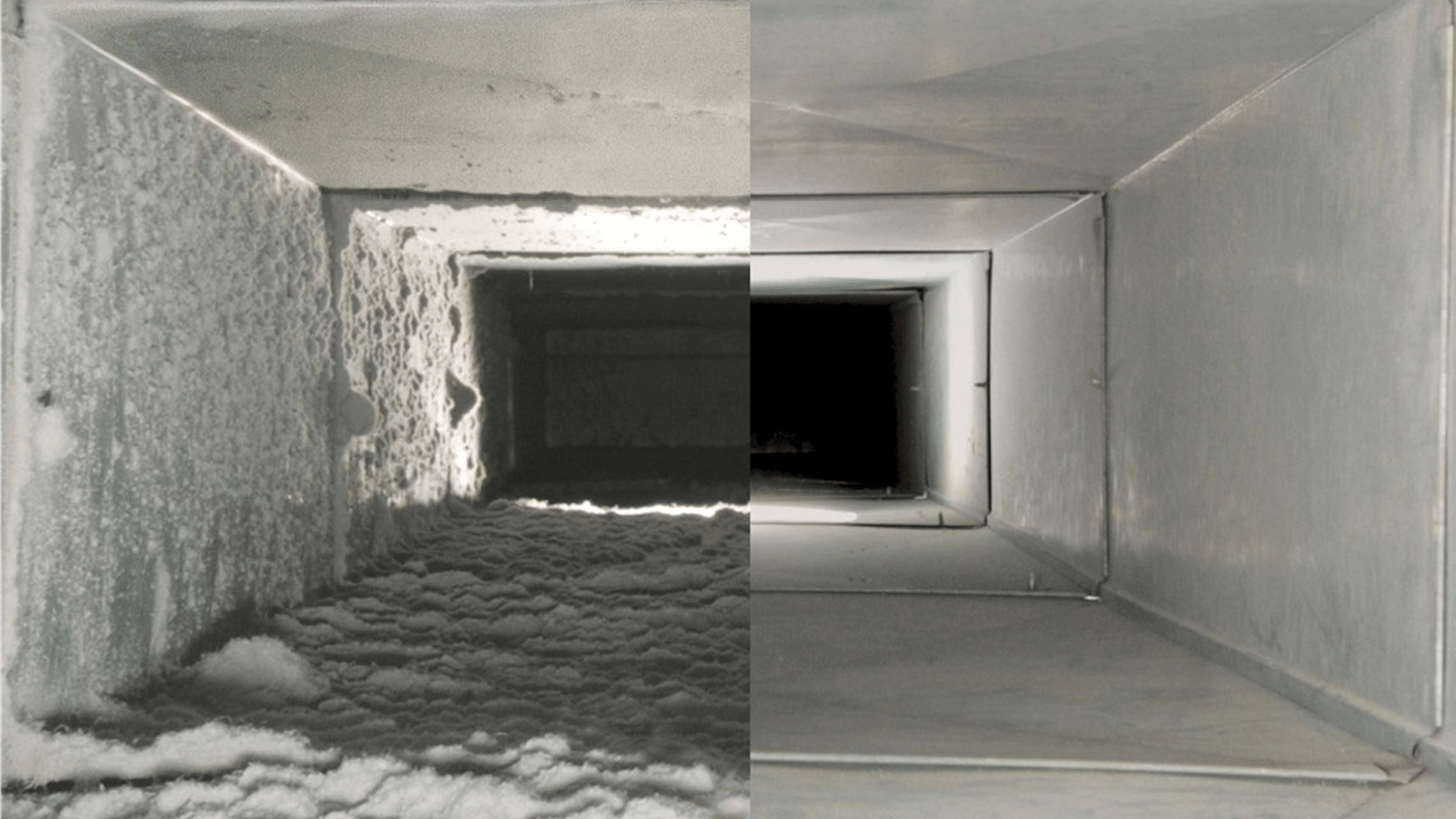
- Clean the agreed system components and review the result. Before-and-after photos help you see the work in areas you would otherwise have to take on faith.
NADCA’s cleaning-method overview explains source removal and negative pressure. Its equipment guidance explains why appropriate tools and careful handling of different duct materials are important. You should leave the appointment understanding what was done—and with more to go on than, “Trust us, it was dusty.”
Powerful Extraction. The Dirty Air Goes Outside.
Phillips uses a trailer-mounted vacuum capable of moving up to 16,000 cubic feet of air per minute, or CFM. That powerful airflow supports the negative-pressure cleaning process, drawing loosened dust and debris through our collection hose to the equipment outside your home.
The destination matters as much as the suction.
Our collection unit and vacuum exhaust stay outdoors. The air we extract from your ductwork is carried out of the house, and the vacuum exhaust is released outside rather than back into your living space.
Some indoor collection systems return HEPA-filtered exhaust to the room. Those systems depend on appropriate filtration and properly maintained equipment. NADCA requires HEPA filtration for vacuum equipment exhausting indoors, along with equipment cleaning and inspection before a project.
With Phillips, outdoor extraction is part of the plan from the start. Our trained team combines that equipment with the access and cleaning methods your system requires.
You have worked hard enough to get the dust out of the living room. Keeping our vacuum exhaust outside is one more detail worth asking about.
Included With Your Cleaning: Dryer Vent Care and a Fresh Finish
Your duct-cleaning appointment includes two additional services at no extra charge:
- Complimentary dryer vent cleaning. We address lint buildup in the separate exhaust vent that carries air from your dryer outdoors.
- Complimentary antibacterial and deodorizing spray service. Following physical cleaning, we apply treatment where appropriate for the system and in accordance with the product’s labeled directions.
The dryer vent deserves particular attention. Lint buildup is a fire-safety concern that is easy to overlook when the laundry is still getting done.
The U.S. Fire Administration reports that failure to clean was the leading factor contributing to home clothes-dryer fires in its 2018–2020 data, accounting for 31% of those fires. That gives dryer vent maintenance a place on the home-care list well beyond whether the towels need another cycle.
The spray service follows the physical removal of dust and debris. We can explain the product, where it will be used, and any preparation or ventilation instructions before treatment. NADCA’s guidance calls for antimicrobial treatments to follow mechanical cleaning and be used when appropriate.
One appointment helps you take care of more of the work happening behind the scenes at home.
How Much Does Air Duct Cleaning Cost in La Crosse?
The useful price is the one tied to your home and a clearly defined scope.
A home with one furnace and accessible ductwork presents a different job from a larger property with multiple systems, difficult access, or an unusual cleanup need.
When you contact Phillips, we will discuss details such as:
- Your home’s approximate size and the number of HVAC systems
- Furnace locations and access to the ductwork
- What you have noticed and any recent remodeling or pest concerns
- The work included in the cleaning
- Access to the dryer vent for the complimentary cleaning included with your service
When comparing proposals, ask each company to explain the same things. Does the price include both supply and return ducts? Which equipment components are covered? What could change the total? How will the results be shown?
Training, equipment, time, and scope all belong in the value conversation. A price is much easier to evaluate when you know what it buys.
You should understand the investment before the work begins. Start a conversation with Phillips about a proposal for your home.
Give the Hidden Parts of Your Home Some Attention
Maybe you have just moved in and want to get acquainted with the parts of the house the listing photos skipped. Maybe a remodeling project left you wondering where all that dust went. Maybe the question has simply been sitting on your to-do list for years.
As cooler weather arrives in the Coulee Region, it is a practical time to bring those questions forward before your winter calendar fills up.
Phillips has served this community for more than 50 years. Our role is to help you understand the work your home needs, explain the options, and make the next step manageable.
Your Simple Three-Step Plan
- Tell us about your home. Share what you are noticing, what has changed, and what you would like us to help answer.
- Review the scope and proposal. Understand what will be cleaned, how the work will be approached, and what it will cost.
- Let our trained, certified professionals handle the cleaning. We will walk you through the findings and results so you know what received attention.
You already have enough places to dust. Let us help with the ones that require a little more equipment than a cloth and good intentions.
Start the conversation with Phillips or call (608) 783-4200. We help homeowners in La Crosse, Onalaska, Holmen, West Salem, and the surrounding Coulee Region take the next step toward a home that feels cared for, including the places behind the vents. And if there is an opossum involved, we have a story to compare notes with.
Frequently Asked Questions About Air Duct Cleaning
Is air duct cleaning worth it?
It can be when there is a specific buildup or contamination problem to address. Ask to see the findings, understand the recommended work, and review the price. That gives you a useful basis for deciding what your home needs.
How often should air ducts be cleaned?
There is no single schedule for every home. The EPA recommends cleaning as needed, based on actual conditions. Read the EPA’s guidance.
Will duct cleaning cure allergies or eliminate all household dust?
No. Cleaning removes material from the system; it cannot promise allergy relief or a dust-free home. Filtration, household cleaning, and moisture control still matter. The EPA explains the limits of duct-cleaning claims.
What equipment does Phillips use, and where does the extracted air go?
Phillips uses a trailer-mounted vacuum capable of moving up to 16,000 CFM. Extracted air and loosened debris travel through a hose to the collection equipment outside your home. The vacuum exhaust stays outdoors.
Are antibacterial and deodorizing spray services included?
Yes. Phillips includes complimentary antibacterial and deodorizing spray service with duct cleaning. Treatment follows physical cleaning and is applied where appropriate for the system, according to the product’s labeled directions. We can explain the product and application before service.
Is Phillips a NADCA member with certified professionals?
Yes. Phillips is a NADCA member company, and our team includes trained, NADCA-certified air-system cleaning professionals. We bring that training and commitment to professional standards to the work in your home.
Is dryer vent cleaning included with air duct cleaning?
Yes. Complimentary dryer vent cleaning is included with Phillips’ duct-cleaning service. It addresses lint buildup in the dryer’s separate exhaust vent as part of the same appointment.
How do I get an air duct cleaning quote near me?
If you live in La Crosse, Onalaska, Holmen, West Salem, or a surrounding Coulee Region community, contact Phillips or call (608) 783-4200. Share your address, approximate home size, number of furnaces, and any concerns. We will help you understand the next step.
Tags: