

Why Does My Yard Flood Every Spring in the Coulee Region?
By Tory Schulz, Director of Revenue & Growth, Phillips
Last updated: November 17, 2026
The Short Answer
Spring yard flooding often happens when snow melts faster than frozen or saturated ground can absorb it. Low spots, compacted soil, runoff from uphill, and downspout placement can make the problem worse. Some puddles disappear as conditions improve. Water that repeatedly collects near the house or keeps part of your yard unusable deserves a closer look. Phillips can help with grading, drainage (including French drains and drain tile), retaining walls, and patios, and we handle any required permits in-house.
Key Takeaways
- Spring melt can sit in the yard when the ground is still frozen or saturated, even if the same lawn drains reasonably well in summer.
- In the Coulee Region, bluffs, coulees, and fine silt-loam soils can send water downhill and hold it longer than sandier ground.
- Karst geology can explain springs and seeps on a bluff hillside, or a sinkhole. It is not usually why a low spot in the lawn ponds in March.
- The ground around your home should slope away from the foundation, and downspouts should discharge well away from the house.
- Phillips can help with grading, French drains, drain tile, retaining walls, and patios, planned around how water actually moves across your property.
- If a drainage or grading job needs a permit, or if an HOA requires approval, Phillips handles that paperwork in-house.
- You don’t have to wait for the puddle to return before starting the conversation.
You weren’t hoping for a pond.
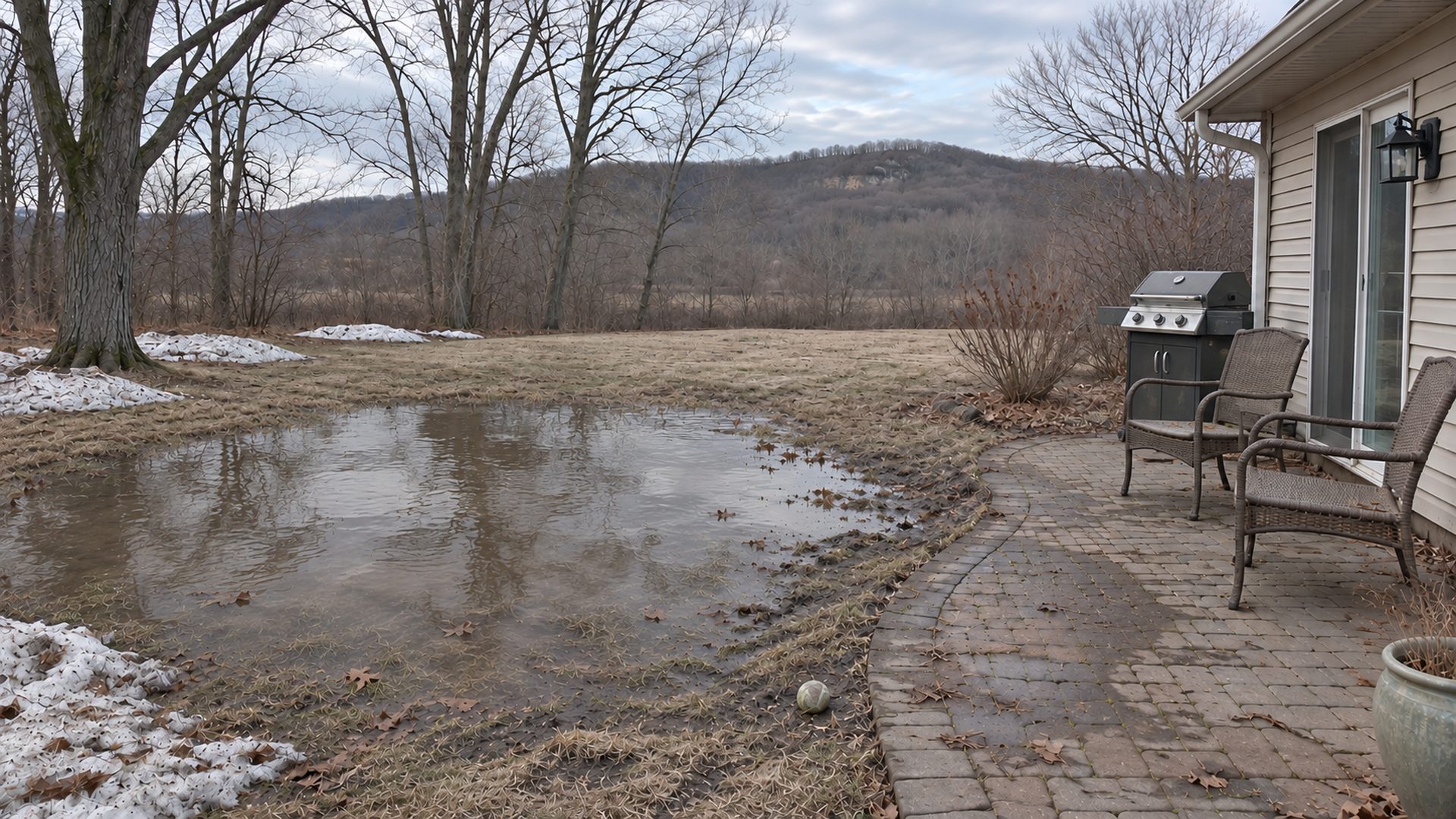
You were hoping for the first weekend the snow finally gives up, the kids can find the soccer ball, and you can walk to the grill without scouting a route.
Then the thaw arrives, the sun does its job, and the low spot by the patio becomes a feature you never put on the plan. Boots park by the back door. The dog develops strong opinions about the new shoreline.
And the same question comes back every year: Why does this keep happening?
For homeowners in La Crosse, Onalaska, Holmen, and West Salem, the answer often involves a combination of spring weather and the way water moves through the property.
The good news? You don’t need to become a soil scientist on a Saturday to start understanding it.
At Phillips, we believe the space around your home should work for the life you want to live in it. That starts with understanding what’s getting between you and enjoying your yard—even when it’s a puddle you’ve started recognizing from year to year.
Why Does My Yard Flood in Spring but Seem Fine in Summer?
The snow and the soil don’t always agree on when winter is over.
A few warm days can melt a substantial amount of snow while the ground underneath remains frozen. That frozen soil can restrict absorption, leaving meltwater to run across the surface and collect in low areas. UW-Madison Extension identifies frozen ground as a cause of spring runoff and erosion.
The City of La Crosse describes stormwater runoff in the same practical terms: it is rainwater or snowmelt that does not soak into the ground, but runs off lawns, roofs, parking lots, and roads.
That helps explain why a lawn that handles an ordinary summer rain may develop standing water during the spring thaw.
Watch what happens as conditions change. Does the puddle gradually disappear? Or does the same area stay soggy and refill whenever it rains?
That distinction gives you something useful to bring into a conversation about drainage. So do photos showing where the water collects and how far it spreads.
Do the Soil and Slopes in My Yard Make a Difference?
Absolutely. Two neighboring yards can have very different drainage problems.
Soil texture affects how water moves. Sandier soils generally drain more readily than clay-rich soils. Compaction adds another obstacle: when soil particles are pressed tightly together, there is less pore space for water to enter and move through. Vehicle traffic and repeated foot traffic can contribute to that compaction. The Wisconsin DNR notes that soil compaction is worth avoiding when a new yard is being established.
But soil is only part of the picture.
A property at the bottom of a slope may receive runoff from land above it. A driveway or patio can also influence where water travels. Your low spot might be collecting water from a much larger area than you realize.
Gravity does not take the season off.
That’s why a useful drainage assessment looks beyond the puddle itself:
- Where is the water coming from?
- What route does it follow?
- Where can it go without creating another problem?
Filling the spot where water collects may change its destination without addressing why it arrives there.
Does the Coulee Region’s Landscape Make Spring Flooding More Likely?
It can. The hills, soils, and bedrock around La Crosse, Onalaska, Holmen, and West Salem shape where water goes. They do not all explain a puddle in the same way.
Bluffs and coulees send water downhill. The Coulee Region sits in the Driftless Area, the part of southwest Wisconsin that the last glaciers did not cover. The Wisconsin Geological and Natural History Survey describes La Crosse County as a place of broad river terraces and, to the east, the steep, hilly coulee country, with near-vertical bluffs of sandstone and dolomite. A yard at the bottom of a slope, at the base of a bluff, or at the end of a driveway often collects more water than the snow that melted on that lawn.
The soils play a part too. La Crosse County describes this landscape as steep bluffs and deep coulees covered by rich, fertile, wind-blown silt loam, with soils formed from weathered sandstone, loess (wind-laid silts), and water-laid silts or sands on stream terraces. Fine silt loam and tighter, slower-draining layers will not drink a sudden melt as quickly as a sandier lot.
Karst is a different story, and it is worth getting right. In parts of this region, water can dissolve dolomite and limestone, forming a karst landscape. The Wisconsin Geological and Natural History Survey explains that karst features can include springs, seeps, disappearing streams, and sinkholes, and that those openings can carry water quickly into groundwater. That helps explain why a spring might come out of a bluff hillside. It is not usually why a low spot in the lawn ponds in March.
A puddle on the grass is almost always a surface-drainage problem: frozen ground, soil, slope, grade, and where the roof water lands. If you see a new hole, a collapse, or water disappearing into the ground in an unusual way, that deserves a careful, separate look. For the ordinary spring pond, start with the yard itself.
Could the Ground Around My House Be Sending Water the Wrong Way?
Yes—and this is one area worth checking early.
The ground next to your home should direct surface water away from the foundation. The City of La Crosse specifically recommends maintaining soil that slopes away from the house as a way to help keep water out of the basement. City of La Crosse, WI
Over time, the layout around a home can change. Soil settles. Planting beds get revised. Walkways and patios are added. What once provided a clear route away from the house may no longer work as intended.
Look for places where water collects beside the foundation or where the ground appears to dip toward the wall.
A puddle in the middle of the lawn can be frustrating. Water collecting against the house deserves prompt attention—especially if you are also seeing moisture indoors.
The goal is to understand the drainage path before adding soil or changing elevations. A fix should account for the surrounding yard, nearby surfaces, and the home itself.
Are My Downspouts Feeding the Same Puddle?
They might be.
Your roof gathers water over a large area and delivers it to just a few outlets. Where those outlets discharge can make a meaningful difference.
The City of La Crosse recommends extending downspouts at least six to ten feet away from the basement and keeping them disconnected from footing drains. City of La Crosse, WI
Distance is only part of the check, though. Follow the water beyond the end of the downspout.
Does it move away from the home? Does it run back toward the foundation? Does it empty directly into the low spot that already stays wet?
An extension that delivers water farther away but into the same trouble spot may not accomplish much.
Downspout placement is a sensible place to start a drainage conversation. Sometimes it reveals a straightforward improvement. Sometimes it shows that the roof runoff and the yard’s grading need to be addressed together.
What Can I Check Before Calling Someone?
You don’t need a drainage drawing. A few observations and photos are a useful starting point.
When you can observe safely from firm ground, look for these five things:
- Where water collects. Note whether it sits in the lawn, along a patio, at the bottom of a slope, or beside the house.
- When it happens. Is it limited to snowmelt, or does it return after ordinary rain?
- How long it lasts. Take photos over several days so you can show whether the area is improving.
- Where water enters the area. Look at downspouts, driveways, uphill ground, and melting snow piles.
- What it leaves behind. Washed-out mulch, sediment, and eroded soil can help show the route water took.
Give wet soil time to dry before working it or driving equipment over it. UW-Madison Extension advises avoiding traffic and soil work while the ground is waterlogged. Wisconsin Horticulture
And resist the urge to start dumping soil into the puddle before understanding the surrounding elevations. The objective is more useful yard—not a puddle with a forwarding address.
How Can Phillips Help With a Yard That Stays Wet?
We start with what you want to do in the space.
Maybe you want to reach the grill without muddy shoes. Give the dog a usable backyard. Enjoy a patio that doesn’t collect runoff. Or address water that keeps gathering beside your home.
Those goals help shape the conversation.
Our landscape construction services include grading and drainage, patios, steps, and retaining walls. The consultation considers how you use the property and which conditions need to improve.
Depending on the site, a plan could involve reshaping part of the yard, improving the route water takes, or incorporating drainage into a larger landscape project. That drainage work can include French drains and drain tile. A French drain is a gravel-filled trench with a perforated pipe that collects water in a wet area and carries it to a better outlet. Drain tile is underground perforated pipe that picks up water in the soil, often around a foundation or through a chronically wet part of the yard, and moves it away. A retaining wall can hold a slope and help manage how water moves across a grade change. A patio should be planned so the new surface does not become the next place water collects.
If you are also considering a patio or changes to a slope, it makes sense to discuss those goals together. You want the finished space to work as a whole.
We’ll explain what we recommend and why. For the landscape construction work we undertake, Phillips handles required permitting and HOA paperwork as part of the process.
We’ll also be clear about what the project can accomplish. Water arriving from a larger drainage area, groundwater conditions, or issues involving public infrastructure may require evaluation beyond the landscape work on your property. Persistent wetness can have more than one cause; a high water table, for example, can keep soil wet even when surface grading looks reasonable. UW-Madison Extension
You deserve a recommendation based on what is happening in your yard.
When Should I Start Planning a Drainage or Landscape Project?
Start while you can still describe the problem clearly.
If the yard is wet now, document it. If it has dried out, gather any photos you took and make notes about where water collected.
Late fall and winter can be useful times to discuss your goals, review those observations, and begin planning. An on-site assessment and construction schedule will depend on conditions, access, and the work involved.
You don’t have to wait for the puddle to return before starting the conversation.
That is especially helpful if drainage is part of a larger outdoor project. A new patio, changes to planting areas, or improvements around a deck should account for how the surrounding space drains.
For a starting budget range on related improvements, the Phillips Project Estimator can help you explore selected services. It does not provide a site-specific drainage quote. That requires a closer look at the property and the scope of work.
What Does Getting Started Look Like?
You don’t need to arrive knowing the correct name for a swale.
Here’s the plan:
- Tell us what you’re seeing. Share where water collects, when it happens, and how it affects your use of the yard. Photos help.
- Talk through the next step with a Client Guide. We’ll discuss your goals and determine whether an on-site consultation makes sense.
- Review a plan for the work. If a project is appropriate, we’ll explain the proposed improvements, scope, and next steps so you can make an informed decision.
You bring the experience of living with the yard. We bring the questions and planning that help move the conversation forward.
What Else Do Homeowners Ask About Spring Yard Flooding?
Can I just add soil to the low spot?
Sometimes correcting an elevation is part of the solution. But the surrounding drainage matters too. Filling one depression without considering where the displaced water will go can create a new wet area. The right approach depends on the property.
Does a wet yard automatically need a retaining wall?
No. A retaining wall may belong in a project involving a slope or a change in elevation, but standing water alone does not establish that need. We start by looking at the site and the problem you want to solve.
Will a drainage improvement keep my yard dry in every storm?
That is not a promise we would make. The plan needs to account for the site’s conditions and the water it receives, with a clear explanation of expected improvements and limitations.
Should I wait until spring to contact Phillips?
You can begin the conversation earlier. Notes and photos from previous wet periods help us understand your concerns, and we can discuss when conditions will allow a useful property assessment.
Will a French drain or drain tile fix a wet yard?
They can be part of the plan, but they are not a one-size-fits-all fix. Phillips installs both. A French drain is a gravel-filled trench with a perforated pipe that collects water in a wet area and carries it to a better outlet. Drain tile is underground perforated pipe that picks up water in the soil, often around a foundation or through a chronically wet part of the yard, and moves it away. Both need a place for the water to go, and they work best when they are planned with the grade of the yard, not dropped in as a standalone cure. We will help you determine whether one of them, a regrade, a retaining wall, or a combination is the right fit.
Do I need a permit for drainage or grading work?
Often, yes, depending on the scope of the work and which community your property is in. You do not have to sort that out yourself. Phillips handles any required permits for drainage, grading, or retaining-wall work in-house, and if your HOA requires approval, we will handle that paperwork as well. That is a value-add, not an extra assignment for you.
How far should the ground slope away from my house?
Wisconsin’s Uniform Dwelling Code requires the finished soil grade to slope away from the dwelling at a rate of at least 1/2 inch per foot for at least 10 feet, unless an approved alternative provides equivalent drainage. Impervious surfaces must also slope away for at least 10 feet. Where space is tight, swales or other means must still send water away from the house. That is the standard in Wis. Admin. Code SPS 321.12.
How far should downspouts discharge from the foundation?
The City of La Crosse recommends extending downspouts at least six to ten feet away from the basement and directing them to the lawn, not onto a driveway or against the house, and not into the footing drain. The Wisconsin DNR also recommends sending roof runoff to the lawn rather than to pavement or the street. If a downspout currently empties into the same low spot that floods, moving that outlet is a smart first check.
Ready for a Spring That Doesn’t Start With a Puddle?
You probably want the first nice weekend to be about being outside.
A little grilling. A little sunshine. A dog that comes back in roughly the same color it went out.
If the same wet spot keeps getting in the way, let’s talk about it.
Start a conversation with Phillips. Tell us where the water collects and what you’d like to enjoy about that space. We’ll help you understand the next step—so you can spend less time planning your route through the yard and more time enjoying it.
Sources
UW-Madison Extension, Gardening for Weather Extremes in Wisconsin: Extreme Precipitation and Organic and Reduced-Risk Lawn Care, A3958.
Wisconsin Department of Natural Resources, What you can do to help (storm water runoff).
City of La Crosse, Stormwater Management and Sewer Backup Prevention, Reporting, and Support.
La Crosse County, Land and Water Resource Management Plan 2020-2029.
Wisconsin Geological and Natural History Survey, Karst and Sinkholes and Geology of La Crosse County, Wisconsin, Bulletin 101.
About the Author
Tory Schulz is Director of Revenue & Growth at Phillips, serving homeowners throughout La Crosse, Onalaska, Holmen, West Salem, and the surrounding Coulee Region. He helps clients take the first steps toward outdoor spaces that work better for their homes and everyday lives.
Tags: